Introduction
Kartik Ahuja growth marketing has become a topic of interest among entrepreneurs, marketers, startups, and business professionals who want to understand modern approaches to customer acquisition, retention, and revenue growth. Growth marketing focuses on using data, experimentation, technology, and customer insights to achieve sustainable business expansion.
Unlike traditional marketing, which often emphasizes brand awareness alone, growth marketing takes a broader approach by optimizing the entire customer journey. From attracting prospects and converting leads to retaining customers and encouraging referrals, growth marketing seeks measurable results at every stage of the business funnel.
This article explores growth marketing principles, key strategies, essential tools, and the role of innovation in driving long-term business success.
What Is Growth Marketing?
Understanding Growth Marketing
Growth marketing is a data-driven marketing approach designed to improve customer acquisition, engagement, retention, and revenue.
Key characteristics include:
- Continuous testing
- Data analysis
- Customer-focused strategies
- Conversion optimization
- Long-term growth planning
The objective is to identify scalable opportunities that help businesses grow efficiently.
How Growth Marketing Differs from Traditional Marketing
Traditional marketing often focuses primarily on attracting attention and generating awareness.
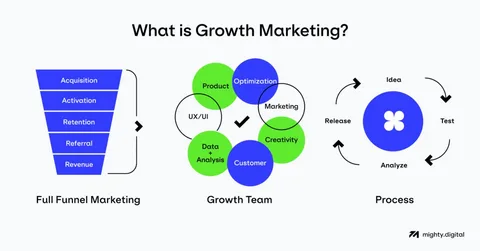
Growth marketing extends beyond awareness by emphasizing:
- Customer acquisition
- User activation
- Customer retention
- Revenue generation
- Referral growth
This comprehensive approach supports sustainable business development.
The Importance of Growth Marketing
Supporting Business Expansion
Growth marketing helps organizations identify opportunities to increase market share and improve performance.
Benefits include:
- Increased customer acquisition
- Better conversion rates
- Improved customer retention
- Higher revenue potential
- Stronger competitive positioning
Businesses often use growth marketing to accelerate expansion.
Data-Driven Decision Making
Modern marketing relies heavily on data and analytics.
Growth marketers use information to:
- Understand customer behavior
- Evaluate campaign performance
- Identify opportunities
- Optimize marketing investments
Data-driven strategies reduce guesswork and improve outcomes.
Building a Growth Marketing Strategy
Defining Business Goals
Every successful growth strategy begins with clear objectives.
Common goals include:
- Increasing website traffic
- Generating leads
- Growing revenue
- Improving retention
- Expanding market reach
Clear goals help guide decision-making and resource allocation.
Understanding the Target Audience
Growth marketers focus on understanding customer needs, preferences, and behaviors.
Research methods include:
- Surveys
- Interviews
- Analytics
- Customer feedback
Audience insights improve campaign effectiveness and personalization.
Customer Acquisition Strategies
Search Engine Optimization (SEO)
SEO helps businesses attract organic traffic from search engines.
Key SEO activities include:
- Keyword research
- Content creation
- Technical optimization
- Link building
Strong SEO can generate long-term visibility and qualified traffic.
Content Marketing
Content marketing attracts and educates potential customers through valuable information.
Popular content formats include:
- Blog posts
- Videos
- Guides
- Case studies
- Infographics
High-quality content builds trust and authority.
Paid Advertising
Growth marketers often use paid advertising to accelerate results.
Common channels include:
- Search advertising
- Social media advertising
- Display campaigns
- Video advertising
Paid campaigns provide opportunities for precise audience targeting.
Conversion Optimization
Turning Visitors into Customers
Attracting traffic is only the beginning. Growth marketing focuses heavily on conversion optimization.
Strategies include:
- Landing page improvements
- Strong calls to action
- Simplified forms
- User experience enhancements
Improved conversions increase the value of marketing efforts.
A/B Testing
Testing different variations helps identify what works best.
Common elements tested include:
- Headlines
- Images
- Buttons
- Layouts
- Messaging
Continuous experimentation supports ongoing improvement.
Customer Retention and Loyalty
Importance of Retention
Acquiring customers is valuable, but retaining them often provides even greater long-term benefits.
Retention advantages include:
- Increased lifetime value
- Lower acquisition costs
- Stronger relationships
- Improved profitability
Loyal customers contribute significantly to business growth.
Customer Engagement
Effective engagement strategies may include:
- Email marketing
- Loyalty programs
- Personalized experiences
- Educational content
Ongoing communication helps maintain customer relationships.
Growth Marketing Metrics
Measuring Success
Growth marketers track performance using key indicators such as:
- Website traffic
- Conversion rates
- Customer acquisition cost
- Customer lifetime value
- Retention rates
Metrics provide valuable insights into campaign effectiveness.
Continuous Optimization
Successful growth marketing involves constant refinement based on data and results.
Regular analysis helps marketers:
- Identify weaknesses
- Improve performance
- Allocate resources effectively
- Increase returns on investment
Optimization is an ongoing process.
Technology and Automation
Marketing Automation
Automation tools help streamline repetitive tasks.
Common uses include:
- Email workflows
- Lead nurturing
- Customer segmentation
- Campaign scheduling
Automation improves efficiency and scalability.
Artificial Intelligence
AI is becoming increasingly important in growth marketing.
Applications include:
- Predictive analytics
- Customer recommendations
- Personalization
- Performance forecasting
AI-powered tools help marketers make more informed decisions.
Building a Strong Brand
Brand Awareness
Although growth marketing focuses on measurable outcomes, brand strength remains important.
Strong brands often benefit from:
- Greater trust
- Higher recognition
- Improved customer loyalty
- Increased referrals
Brand-building efforts support long-term growth.
Consistent Messaging
Consistency across marketing channels helps strengthen brand identity and customer confidence.
Unified messaging creates a more professional and memorable customer experience.
Growth Marketing for Startups
Maximizing Limited Resources
Startups often operate with constrained budgets and resources.
Growth marketing helps by:
- Prioritizing high-impact activities
- Testing efficiently
- Measuring performance closely
- Focusing on scalable opportunities
This approach supports sustainable expansion.
Rapid Experimentation
Startups frequently benefit from quick testing cycles that allow them to learn and adapt rapidly.
Flexibility is often a key competitive advantage.
Future Trends in Growth Marketing
Personalization
Consumers increasingly expect customized experiences tailored to their interests and needs.
Personalization can improve:
- Engagement
- Conversions
- Retention
- Customer satisfaction
Data Privacy
As privacy regulations evolve, marketers must balance personalization with responsible data practices.
Trust and transparency will remain important priorities.
Omnichannel Experiences
Future growth strategies will continue integrating multiple channels to create seamless customer journeys.
Businesses that provide consistent experiences across platforms may gain competitive advantages.
Best Practices for Growth Marketing
Focus on Customers
Understanding and serving customer needs should remain the foundation of all growth initiatives.
Embrace Testing
Continuous experimentation helps uncover opportunities for improvement.
Use Data Effectively
Decisions should be guided by reliable data rather than assumptions.
Prioritize Long-Term Value
Sustainable growth often comes from building strong customer relationships rather than pursuing short-term gains.
Conclusion
Kartik Ahuja growth marketing represents the broader principles of modern growth-focused business strategies that emphasize data, experimentation, customer engagement, and continuous optimization. By combining SEO, content marketing, conversion optimization, retention strategies, and advanced technology, businesses can create scalable systems that support long-term success.
As digital markets become increasingly competitive, organizations that embrace growth marketing principles will be better positioned to attract customers, improve performance, and achieve sustainable expansion in the years ahead.